


I’ve been in Rome for almost two weeks and have been trying to get a feel for more of Rome than the two neighbourhoods I actually spend time in, which are Prati, where I live, and the Spagna area, where I have class. Everything outside of those two places has mostly been theoretical to me. So when I had the chance to volunteer at a soup kitchen in an unexplored area of Rome, finally seeing somewhere new excited me.
At around 9 am I made it to a coffee shop near Via Cavour and met up with the rest of the volunteers before walking to the soup kitchen, and even just standing on the sidewalk I could tell how different it felt from where I’ve been living. Prati has very small roads and big trees that line the streets, so everything is shaded and quiet, but Via Cavour, closer to Termini, is a lot busier and built with bigger roads meant for moving people through the city.
The soup kitchen is Caritas Diocesana di Roma, Mensa Giovanni Paolo II, and when we arrived we got a little bit of a tour.

There’s an initial area outside where people line up, and then when they come in they get a ticket and their visit is recorded down. After that was the cafeteria line, which had more options than I expected, like different kinds of bread, simple pastas, beans, and something that reminded me of Indian curry, with the meat and vegetables cooked down into a paste.
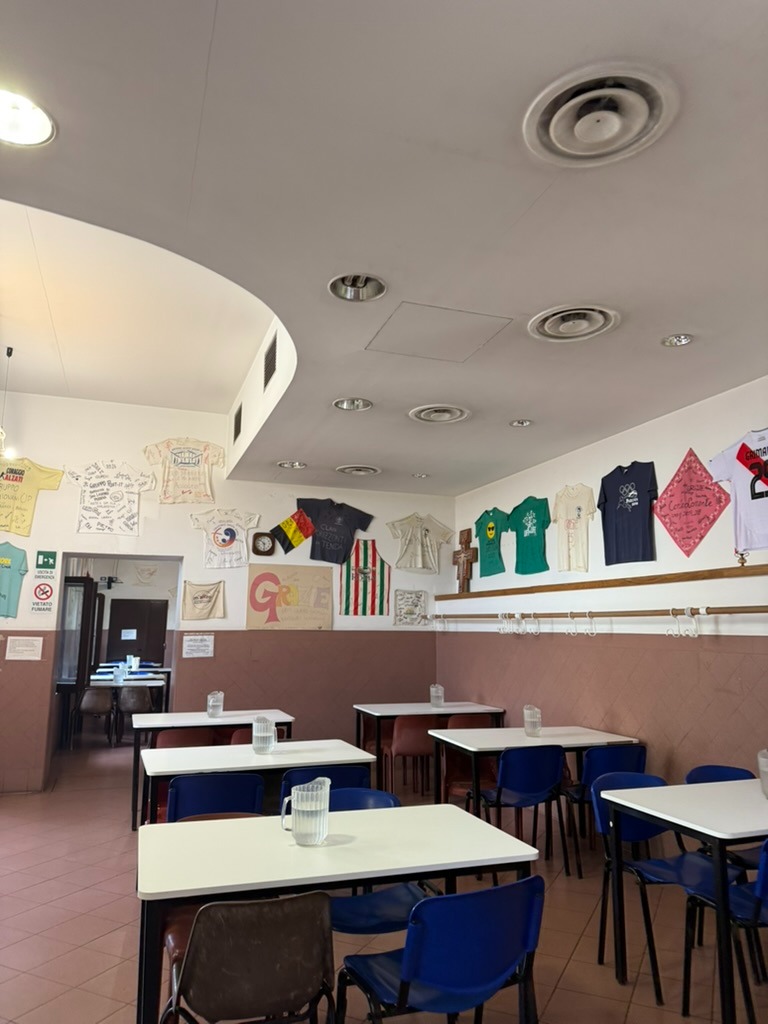
Past the line is the sit down dining area, which is three rooms connected by small doorways and filled with little tables of four chairs. The part I couldn’t stop looking at was the walls. They were covered in T-shirts from different volunteer groups, each one signed by the people who came, and they spanned each and every wall. There were also hand drawn posters that said Grazie, and flags, so the whole room is covered with years of people passing through and leaving behind some small piece of evidence that they were there.
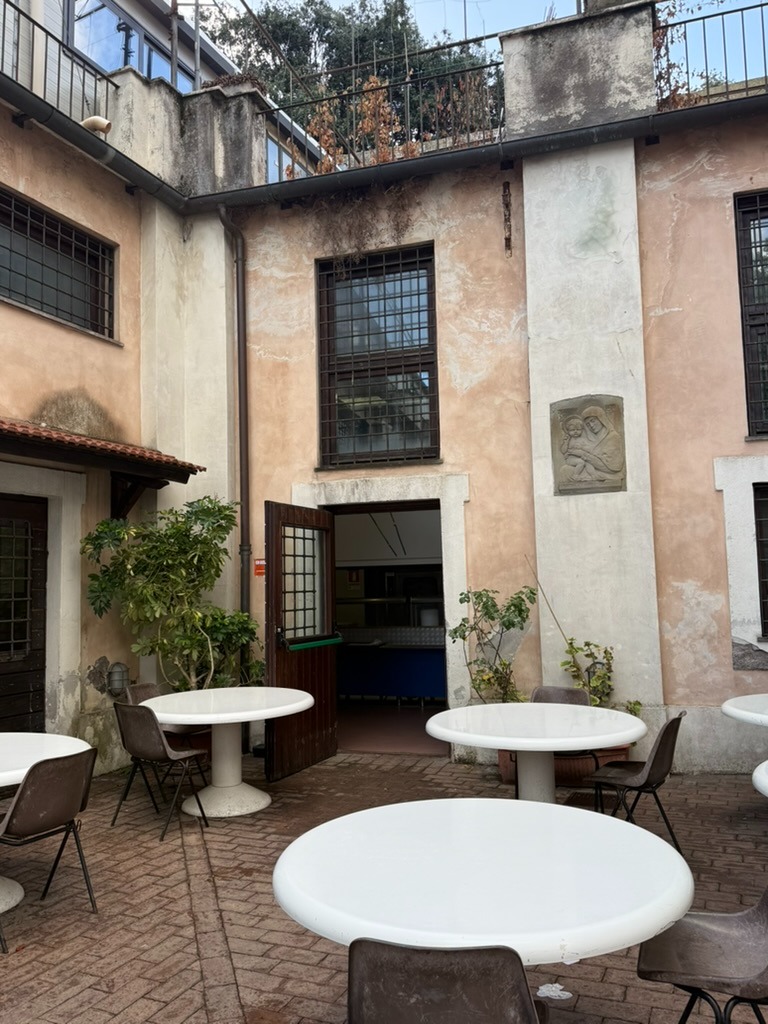
We then went outside to the courtyard where we met another volunteer group that was Italian, a small group of working adults, and I realized I had been in Rome for weeks without having a single real conversation with an ordinary working Italian. I feel like I learned as much about everyday life here from talking with them as I did from anything else that day.
We delegated tasks and I was sent to the cafeteria area to fill up water, clean up tables, and help with people who were done eating.
It was simple work, but the influx of visitors was always constant. I’m an avid people watcher, so as I stood against the wall looking for the next table to clean or the next water pitcher to fill, I would get to watch the visitors come and go. I noticed who walked in with someone and who walked in alone, and who sat down like they had sat in that exact chair a hundred times before. I heard that some of them come every day.
Rome hosts almost three million people, and until that morning I hadn’t really seen any of the strain that comes with a city that size. Back home in Durham, where I study at Duke, there are low-income areas and people living on the street, and it’s a delicate situation that affects the city and a lot of other cities across the US. Rome has the same pressures; it just has more glitz and glamour to hide them behind. If you’re only here for a couple of days, or even a couple of months, you can go the entire time without ever having to think about the fact that anyone in this city is struggling, because the city makes that very easy to do, and I had been letting it.
The visitors of the soup kitchen came from a diverse range of backgrounds, and I noticed a pattern of people of ethnic backgrounds speaking a lot of different languages. Contextually it was understood that many of them were immigrants to Rome or people vying for citizenship, and all of them were just trying to survive another day and have a meal to eat.
My parents immigrated to the US from China almost thirty years ago, searching for success and a way to live an easier life, which is a phrase that only sounds simple if you haven’t done it yourself. My grandparents are still in China, so what my parents traded away wasn’t only distance but people, permanently, in order for me to grow up with the life I had.
I don’t think most people understand how hard the first few years actually are, because how do you build a life for yourself when you can’t even order a meal at McDonald’s due to the language barrier? You work every day to support yourself and then come home alone at night, because the community that knows you is thousands of miles away in the place you left. Standing in that dining room, I saw my parents’ first years in America reflected back at me in a country they have never been to.
What struck me is how little I actually needed in order to recognize any of it. I don’t speak Italian, I didn’t have a single conversation, and I don’t know their names or where they came from or what it cost them to get here. But someone waves me over for more water, and I pour it, and I’m left with a grazie mille that transcends all of those boundaries without either of us needing to share a language. Then they finish and stand up and move on to their next destination for the day, and I’m greeted with a grateful smile and a quiet ciao, and that happened dozens of times over the course of a few hours. In a way, it emphasized how universal the immigrant experience is, because the struggles of one person can be felt even when you don’t know anything about their actual journey.
As I took off my apron and walked back, the city felt more real than it had that morning. I thought about my parents, and about how many parts of their journey I have never heard. In the same way, I’ll never hear the individual stories of the people whose water glasses I filled. Studying abroad is a privilege, and part of what that privilege buys you is the option not to look. However, I’d rather look–and feel with the people living and surviving in this beautiful city everyday.